


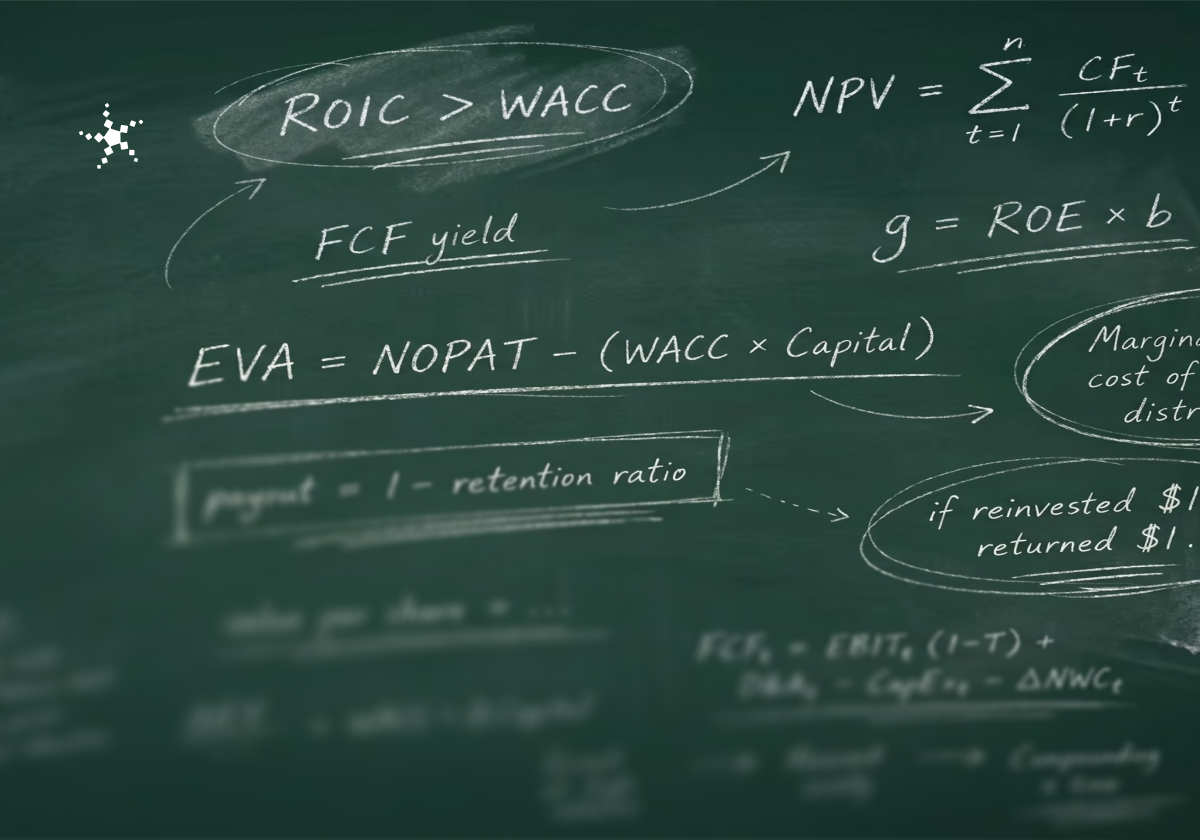
Why Tokens Reward Buybacks and Equity Doesn't
In traditional venture, a portfolio company returning capital to shareholders is a red flag. It signals that management has run out of growth initiatives worth funding. You want reinvestment. Buybacks are for mature companies, not startups.
In crypto, the market rewards the opposite. Aave just passed a proposal to return all protocol revenue to token holders. Hyperliquid distributes $65M/month. Token buybacks returned over $1B across the industry in 2025. And the market generally rewarded these initiatives. [1,2,3]
The traditional investor in me finds this uncomfortable but the pragmatic analyst in me thinks the market has a point. A couple reasons come to mind:
1. We lack strong precedents for protocols profitably reinvesting cash flows
This is the core of it. A startup reinvests by hiring, acquiring, expanding into new markets. Protocols just don't have those levers in the same way. And the things they can spend on (liquidity incentives, grants programs) have delivered limited ROI. Some protocols are exploring adjacent products: Aave is building out a broader financial suite and Uniswap has expanded into its own chain. These are smart expansion opportunities and I suspect these or other efforts will eventually be successful. But, today, the market does not yet have a clear example of a protocol compounding cash flows into a multi-product platform the way a traditional company might. For now, tokens feel like they’re tied to a product rather than a company.
Part of this is structural. Most successful protocols are meaningfully decentralized, which is by design and has real benefits. But it also means product decisions run through governance processes that aren't built for speed. Launching adjacent products requires the kind of focused, opinionated execution that a small team can do and a DAO generally can't. That's not a failure, it's just the current tradeoff that comes with decentralized governance as we know it today, and the consequence is that it narrows reinvestment options.
2. Token holders have never been sure they actually own the economics
With equity, the holder's economic interest in the enterprise has always been well-defined. With tokens, it hasn't. This is partly due to regulatory ambiguity, and partly to the fact that governance structures are still maturing and the mechanisms for directing protocol cash flow to holders are still being established. Against this backdrop, buybacks and fee distribution aren't necessarily signaling "we've run out of ideas", instead they’re staking a flag in the ground: this token is tied to real economic value. Markets like clarity and token holders have lived in economic limbo, so it's no surprise that participants are rewarding projects that offer a concrete answer today over a theoretical optimum tomorrow.
3. Lastly, protocols can reach economic maturity faster than companies
Uniswap, Aave, and Hyperliquid are already processing billions to trillions in volume on live infrastructure. They still need to keep improving the product, and the best ones do, but that is different from assuming every dollar of protocol revenue has a high-ROI reinvestment opportunity. A protocol can go from launch to durable, scaled, cash-flowing infrastructure in just a few years. The crossover point where distributing protocol revenue beats retaining it may arrive much sooner than traditional investors expect.
4. None of this is permanent
The market rewards buybacks today because we don't have strong examples of the alternative working. But crypto has a way of rewriting its own rules. Maybe protocols eventually figure out how to compound cash flows into multi-product platforms. Or maybe they don't need to. Maybe tokens are just something different. Maybe they’re the first asset with direct exposure to a single, high-margin piece of global financial infrastructure. Either way, the playbook definitely isn't set in stone and the market will continue adapting to the evolving reality on the ground.
Footnotes:
1. CoinDesk, "Aave passes landmark vote ending months-long fight over who controls protocol revenue," April 13, 2026. https://www.coindesk.com/tech/2026/04/13/aave-passes-landmark-vote-ending-months-long-fight-over-who-controls-protocol-revenue
2.Tokenomics.com, "Hyperliquid Tokenomics: How HYPE Captures $65M. Monthly in Holder Revenue," February 1, 2026. https://tokenomics.com/articles/hyperliquid-tokenomics-how-hype-captures-65m-monthly-in-holder-revenue
3. The Block, "Crypto token buybacks hit $40 million weekly as protocols mimic corporate repurchase playbook," August 20, 2025. https://stage.theblock.co/post/367488/crypto-token-buybacks-hit-40-million-weekly-as-protocols-mimic-corporate-repurchase-playbook
The content provided herein may include information regarding past and/or present portfolio companies or investments managed by Blockchain Capital or its affiliates and are provided for illustrative purposes only. The views expressed in each blog post are the personal views of each author and do not necessarily reflect the views of Blockchain Capital and its affiliates. Neither Blockchain Capital nor the author guarantees the accuracy, adequacy or completeness of information provided in each blog post. No representation or warranty, express or implied, is made or given by or on behalf of Blockchain Capital, the author or any other person as to the accuracy and completeness or fairness of the information contained in any blog post and no responsibility or liability is accepted for any such information. Nothing contained in each blog post constitutes investment, regulatory, legal, compliance or tax or other advice nor is it to be relied on in making an investment decision. Blog posts should not be viewed as current or past recommendations or solicitations of an offer to buy or sell any securities or to adopt any investment strategy. The blog posts may contain projections or other forward-looking statements, which are based on beliefs, assumptions and expectations that may change as a result of many possible events or factors. If a change occurs, actual results may vary materially from those expressed in the forward-looking statements. All forward-looking statements speak only as of the date such statements are made, and neither Blockchain Capital nor the author assumes any duty to update such statements except as required by law. To the extent that any documents, presentations or other materials produced, published or otherwise distributed by Blockchain Capital are referenced in any blog post, such materials should be read with careful attention to any disclaimers provided therein.





.png)
.png)
.png)

.png)
No Results Found.