



Sanctification & Serendipity
When I have 20 minutes between meetings and I need a coffee, I want to Google Map my way to the closest coffee shop. I have no time to wander. And it’s nice not to think about how to get home from the airport. Uber works. And I don’t want to dig through the nitty-gritty of an airline’s policy page to know if my flight is refundable. Claude can do that for me. But what do we lose when we optimize for convenience?
Modern convenience often comes at the expense of sanctification and serendipity.
The Physical World
I remember going to Blockbuster as a child. You’d spend time wandering the fluorescent aisles, browsing hundreds of movies, maybe asking a stranger for a recommendation before finally settling on one. The plastic case itself gave the movie a certain importance, as though you were handling something worth protecting. You’d bring it home, crack it open, and carefully slip the disc into the DVD player, hoping whoever rented it last hadn’t scratched it. There was something wonderfully tactile and social about the whole experience. All these little rituals sanctified the movie. Contrast that with Netflix recommending something to watch. The movie might be just as good, but the experience feels far less special.
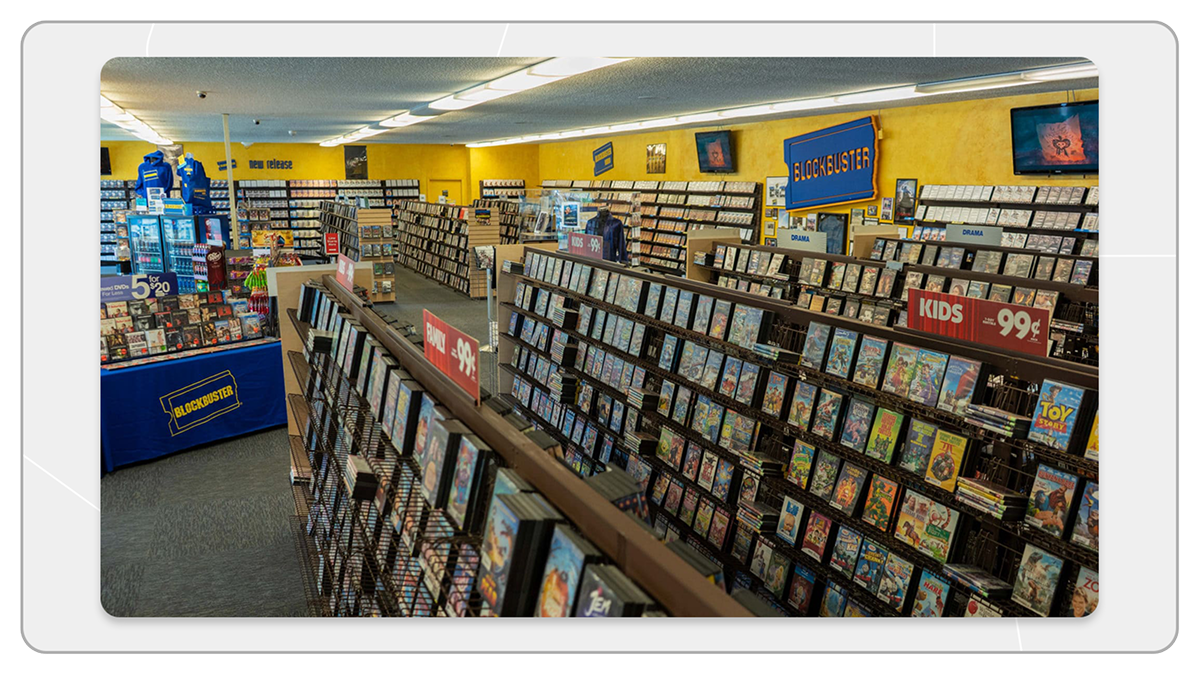
The same is true when I host potlucks. I take pride in the details, be it the spices on a dish or the color of the tablecloth, because I put thought into them. A restaurant might have beautiful decor and clever dishes, but I don’t appreciate them in the same way.
It reminds me of a trope about people who retire. They often describe a sense of emptiness, and many go back to work even if they don’t need the money. Why? Because the work creates meaning in itself.
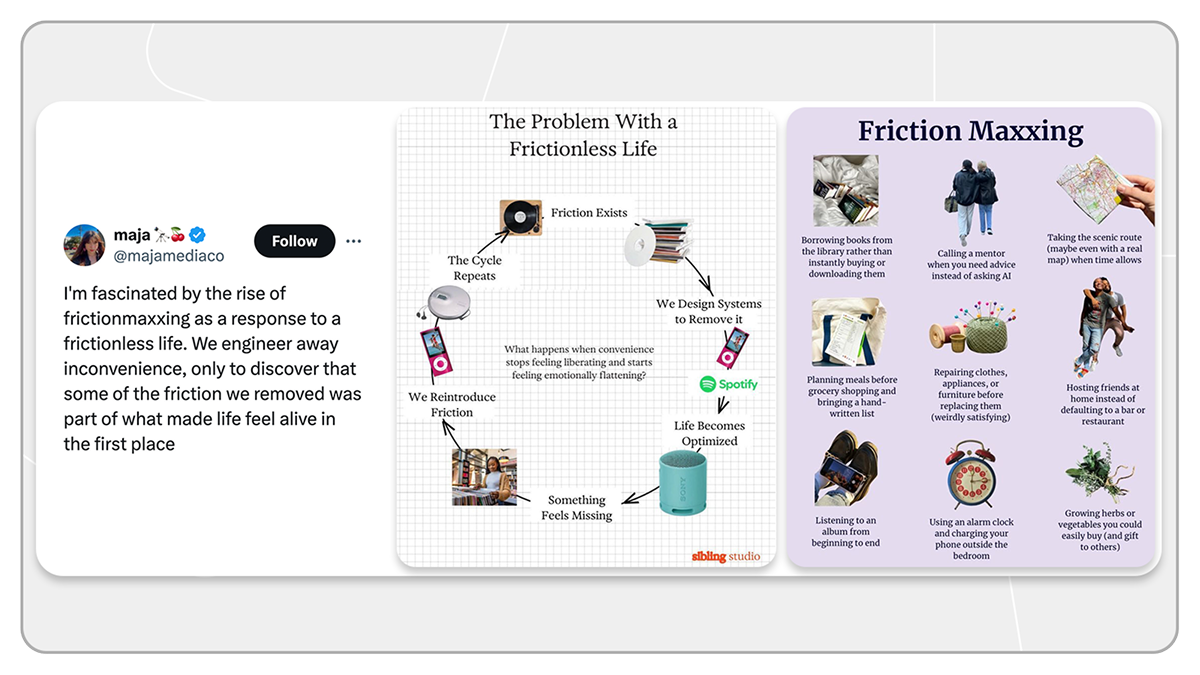
I’m fascinated by the rise of frictionmaxxing as a response to a frictionless life. We engineer away inconvenience, only to discover that some of the friction we removed was part of what made life feel alive in the first place.
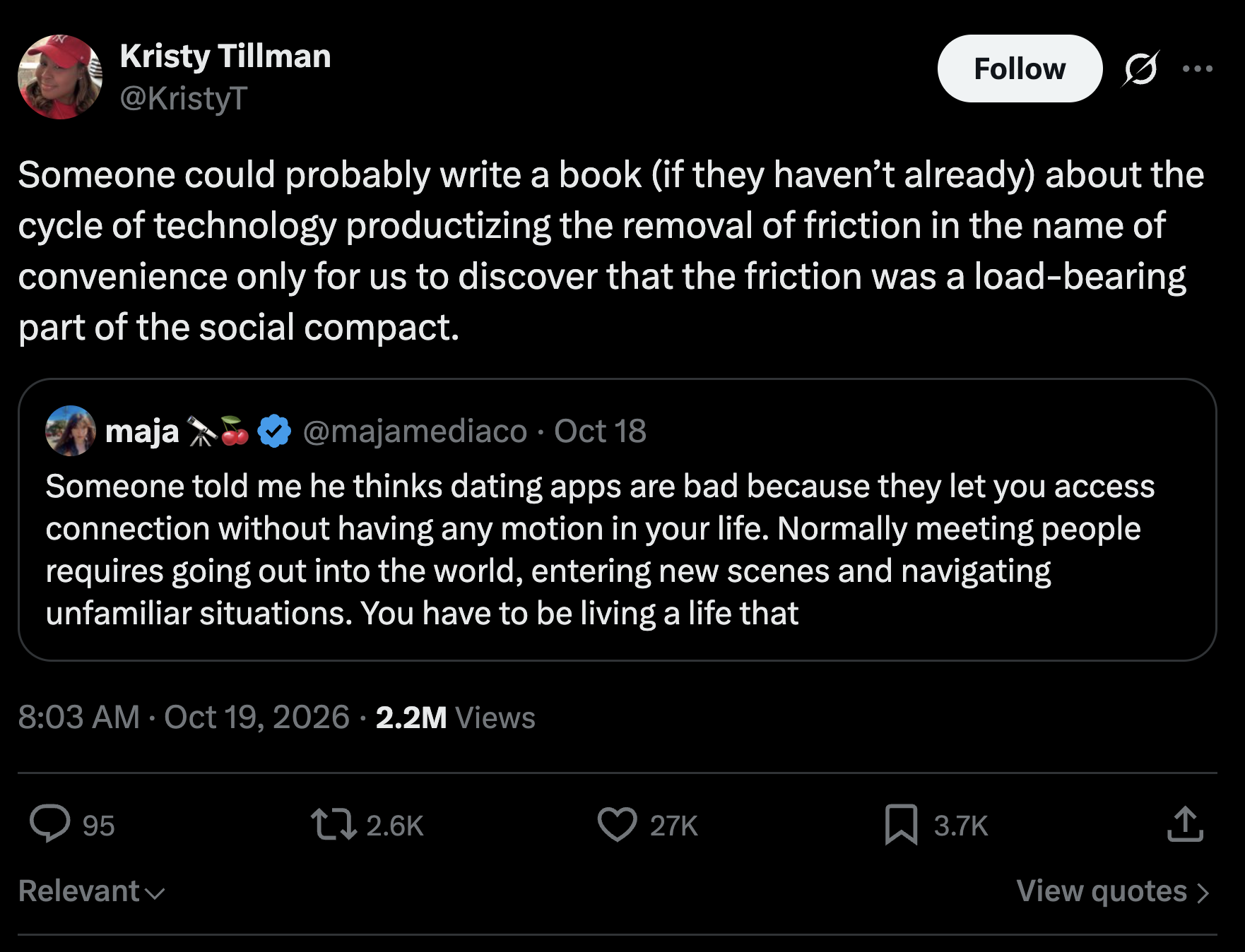
Then there’s serendipity.
I’ve always appreciated Borgo Egnazia in Italy. The grounds are designed to get you lost. Google Maps is unreliable there, so you have to navigate with a paper map, wandering among the twisting paths and villas. You often get lost, but that’s the best part.
Contrast that with using Google Maps. You look up “cute coffee places near me,” choose the one with a 4.6 rating and 81 reviews, and the map gives you the walking route. You lose the opportunity to wander.
The Cognitive World
In the age of AI, the loss of sanctification and serendipity becomes more pronounced. AI is the ultimate form of modern convenience. It allows us to offload thinking.
My cousin is a historian who spends years learning foreign languages and laboring in ancient archives to uncover forgotten histories. Her books carry weight beyond their content because I know how much human sacrifice went into producing them. Now, with AI, research is abundant, models speak all languages, and writing has become so easy that it starts to feel less precious.
I wonder if we’ll see people return to cognitive activities that AI can already perform, much like we’ve seen a return to vinyl records and knitting. Maybe more people will read entire books rather than summaries, and write handwritten letters. Not because those methods produce better outputs, but because there’s something valuable in the act of doing them.
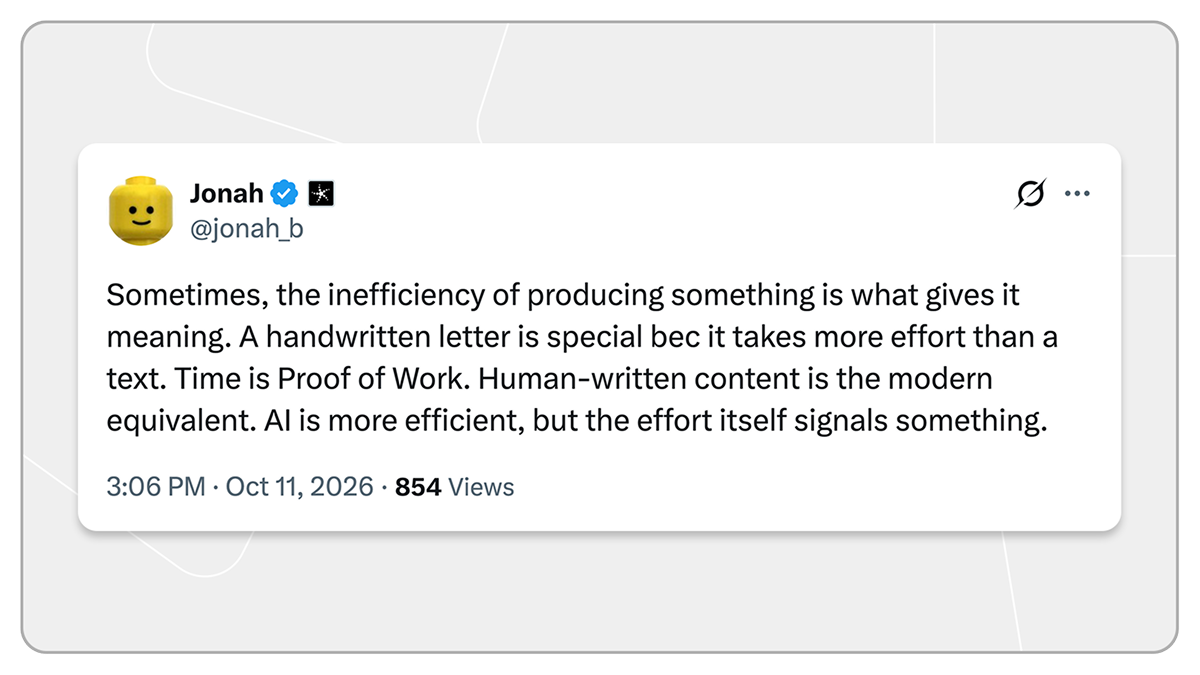
Sometimes, the inefficiency of producing something is what gives it meaning. A handwritten letter is special bec it takes more effort than a text. Time is Proof of Work. Human-written content is the modern equivalent. AI is more efficient, but the effort itself signals something.
I see the rise in chess culture as an early indicator. People devote countless hours to improving their game, even though AI surpassed the best human players years ago. In a lecture on chess culture, Corrine Ciani and A. L. Bahta ask why anyone would bother with this “Icarian task.” Their answer: “It’s because the material awareness of human versus human, player versus player, survival of the fittest is very high. You don’t need to be smarter than the AI. You just need to be smarter than the next guy.” The existence of a superior machine doesn’t kill the value of a chess match. Human effort and competition sanctify the endeavor.
And then there’s the question of what AI does to serendipity.
I’ve written before about how AI research, which improves my productivity, has also stolen some of the serendipity from the process. Before the internet, you had to go find a book in the library. In search of that book, you’d stumble upon authors you’d never heard of. And when digging through a book’s table of contents, you’d inevitably come across unexpected concepts too.
Internet research is much more directed. What you’re trading is access to more information, faster, but with less variance. Still, the internet was unique in that you could chase down links and go down rabbit holes.
AI research pushes that trade further. It often one-shots the research, so you rarely stumble onto adjacent ideas. And a lot of the most interesting ideas come from hearing about them by accident.
The Real World
So how do we preserve sanctification and serendipity?
I’m by no means a Luddite. Uber, Spotify, and ChatGPT have been lovely additions to my life, and I invest in technology that makes the world more convenient. I like that convenient options exist, and I want the world to have more of them.
At the same time, I recognize that while convenience productizes the “ends,” sometimes it’s the “means” we actually value. Just because you have a convenient option doesn’t mean you have to choose it.
There’s a time and place for inefficiency.
The content provided herein may include information regarding past and/or present portfolio companies or investments managed by Blockchain Capital or its affiliates and are provided for illustrative purposes only. The views expressed in each blog post are the personal views of each author and do not necessarily reflect the views of Blockchain Capital and its affiliates. Neither Blockchain Capital nor the author guarantees the accuracy, adequacy or completeness of information provided in each blog post. No representation or warranty, express or implied, is made or given by or on behalf of Blockchain Capital, the author or any other person as to the accuracy and completeness or fairness of the information contained in any blog post and no responsibility or liability is accepted for any such information. Nothing contained in each blog post constitutes investment, regulatory, legal, compliance or tax or other advice nor is it to be relied on in making an investment decision. Blog posts should not be viewed as current or past recommendations or solicitations of an offer to buy or sell any securities or to adopt any investment strategy. The blog posts may contain projections or other forward-looking statements, which are based on beliefs, assumptions and expectations that may change as a result of many possible events or factors. If a change occurs, actual results may vary materially from those expressed in the forward-looking statements. All forward-looking statements speak only as of the date such statements are made, and neither Blockchain Capital nor the author assumes any duty to update such statements except as required by law. To the extent that any documents, presentations or other materials produced, published or otherwise distributed by Blockchain Capital are referenced in any blog post, such materials should be read with careful attention to any disclaimers provided therein.






No Results Found.